
Author Guidelines
KJKS welcomes submissions of original research articles and review papers that fall within the journal's aims and scope. Manuscripts must present original, unpublished work that is not under consideration by any other journal or publication.
LaTeX submissions only
The journal accepts manuscripts prepared in LaTeX only. Microsoft Word, ODT and Google Docs files are not accepted and will be returned without review.This is not a preference — it is what allows the journal to typeset Hangul correctly alongside Latin script, align morpheme-by-morpheme glosses, number and cross-reference examples reliably, and produce consistent APA references. Use the journal's official LaTeX template; it does all of this for you.
Manuscript Requirements
| Element | Requirement |
|---|---|
| Format | LaTeX only. Submit both the .tex source and the compiled .pdf. |
| Template | The official KJKS template. Do not alter the style block in Section 8 of the file. |
| Engine | XeLaTeX or LuaLaTeX. pdfLaTeX will not render Korean. |
| Page setup | A4, 11 pt, single column — set by the template. |
| Anonymity | Keep \anonymoustrue. The manuscript must not name you anywhere, including in the file properties and the acknowledgements. |
| Title page | A separate file with authors, affiliations, ORCIDs, CRediT contributions, funding, conflicts and ethics approval. Never sent to reviewers. |
| Abstract | 150–200 words, no citations. A Korean abstract is encouraged alongside the English one. |
| Keywords | Five, separated by semicolons. |
| References | APA 7th edition via biblatex with the apa style, processed by Biber. |
| Korean examples | Hangul, Revised Romanization, morpheme gloss, free translation — using the expex environment supplied. |
| Tables | booktabs style: three horizontal rules, no vertical rules. Caption above. |
| Figures | Vector PDF or EPS where possible, otherwise 300 dpi minimum. Caption below. |
| Equations | Numbered if referred to; every symbol defined immediately after. |
| Declarations | Data availability, generative AI use, ethics approval and conflicts — all four required, including a statement that none applies. |
Manuscript Types
| Section | Length | Review |
|---|---|---|
| Research Article | 6,000–8,000 words | Double-blind peer review |
| Pedagogy & Practice | 3,000–5,000 words | Double-blind peer review |
| Translation Note | 2,000–4,000 words | Double-blind peer review |
| Field & Data Report | 2,000–3,500 words | Double-blind peer review |
| Book & Media Review | 1,000–1,500 words | Editorial review |
Word counts exclude references and appendices. Name your chosen section in the covering email and in the template's
\papersection field. If you are unsure which section fits, say so and an editor will place it.
Authors connected to The Korean Academy
Students and alumni are welcome to submit
If you are a student, alumnus, teacher or member of staff of The Korean Academy, you may submit your manuscript to this journal and we would be glad to read it. Declare the connection on your title page — it does not count against you.Your manuscript is then handled by an independent editor with no connection to you, who chooses the reviewers and takes the decision alone. It receives the same double-blind review as every other submission, against the same standards.
Acceptance depends entirely on the outcome of that review. Being a KORA student does not make publication more likely, and it does not make it less likely. Nor is anyone required or expected to publish here: if your studies include a research project, you are free to submit it to any journal you think suitable, or to none.
Language
Manuscripts are accepted in English or Korean. Where the article is in Korean, supply the English abstract; where it is in English, a Korean abstract is welcome. We do not reject work for imperfect English, but we do return work whose argument cannot be followed.
LaTeX Template
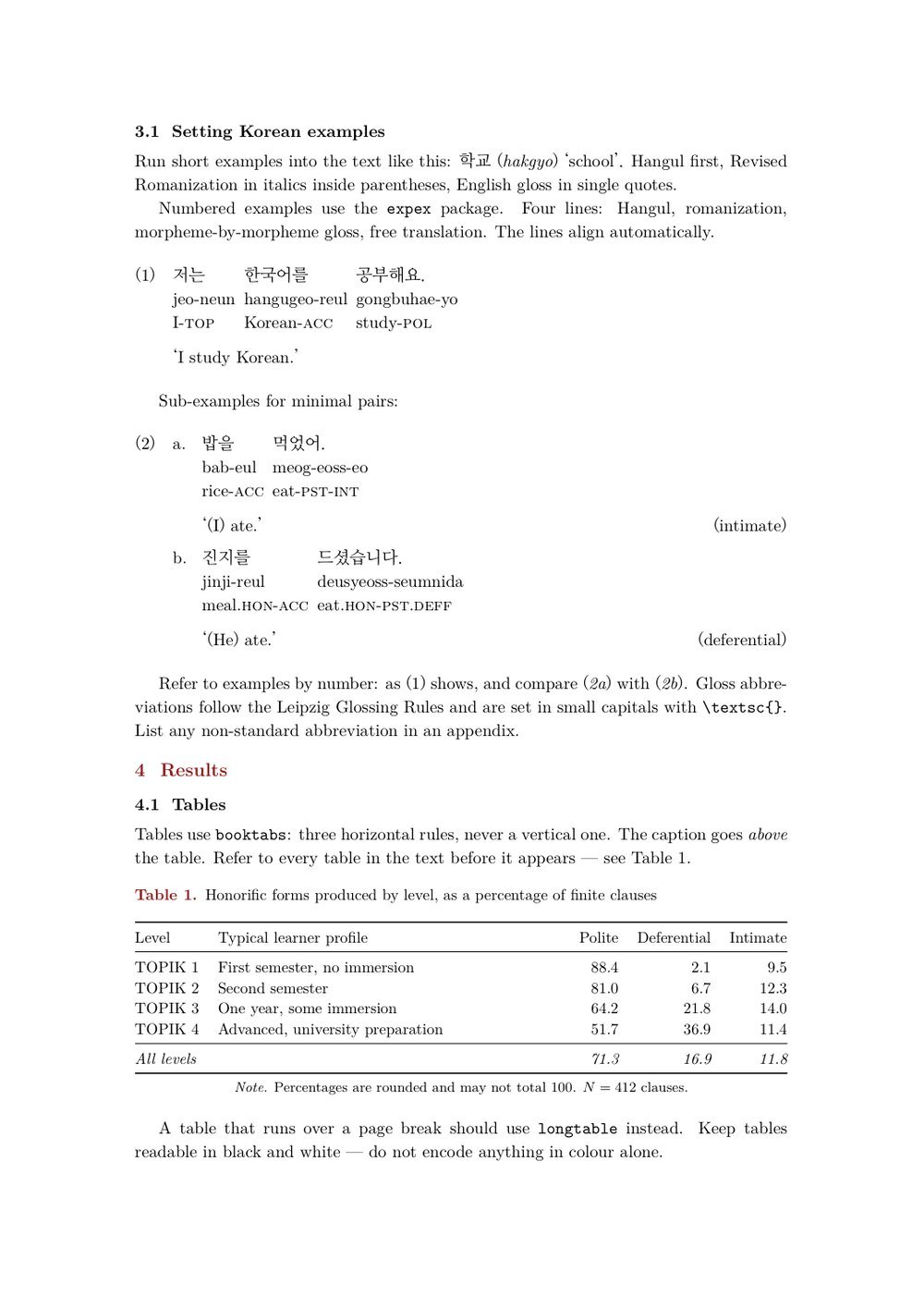
Every KJKS manuscript is written in the journal's official LaTeX template. It is a single self-contained file — no class file, no separate bibliography to hunt for — and it compiles as it stands, so you can see the finished layout before you have written a word.
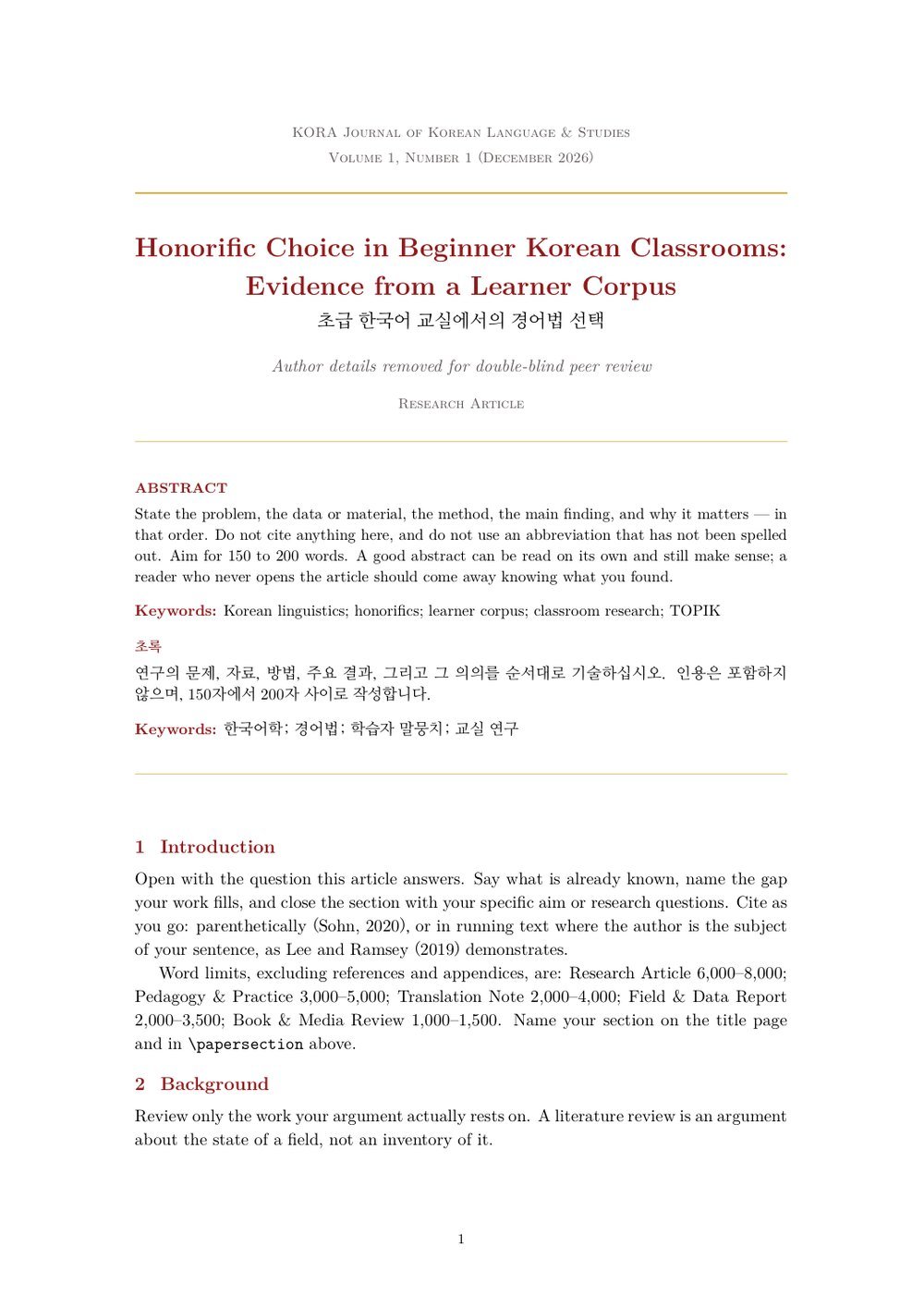
Download the template
Copy the complete source below, then paste it into a new file named
kjks-article.tex — or straight into a blank Overleaf project.
TEX
What the template gives you
- Correct Hangul. Loads
kotexand falls back through three Korean faces, so the file compiles whatever is installed on your machine. - A one-line anonymity switch.
\anonymoustruehides every author detail for double-blind review; flip it to\anonymousfalsefor your own copy. - Glossed linguistic examples. Four-line
expexexamples — Hangul, romanization, morpheme gloss, translation — that align automatically and number themselves, with sub-examples for minimal pairs. - Tables and figures already set in the journal's style, with captions in the right place and a worked example of each.
- Equations with numbering, cross-referencing and APA statistical conventions.
- APA 7th references through
biblatex, with three sample entries written into the file so it compiles before you add your own. - The declarations block the journal requires, with the wording for each.
- Instructions in the file itself — every section explains what belongs in it. Delete the guidance as you write.
How to compile
On Overleaf — the easiest route.
- Create a blank project and paste the source into
main.tex. - Open Menu → Compiler and choose XeLaTeX.
- Under Menu → TeX Live version, select 2023 or later.
- Press Recompile. The bibliography is written automatically on the first run.
xelatex kjks-article → biber kjks-article → xelatex kjks-article → xelatex kjks-article
Compile with XeLaTeX or LuaLaTeX, never pdfLaTeX — Korean text will not render. References are processed with Biber, not BibTeX. This template has been compile-tested end to end and produces no warnings.
kjks-article-template.tex 502 lines · press Copy above, then save as a .tex file
%%%%%%%%%%%%%%%%%%%%%%%%%%%%%%%%%%%%%%%%%%%%%%%%%%%%%%%%%%%%%%%%%%%%%%%%%%%%%%%
%%
%%  KORA JOURNAL OF KOREAN LANGUAGE & STUDIES  (KJKS)
%%  코라 한국어 및 한국학 연구 저널
%%  Official manuscript template  --  Version 1.0  (2026)
%%  Published by The Korean Academy
%%
%%  ---------------------------------------------------------------------------
%%  HOW TO COMPILE
%%  ---------------------------------------------------------------------------
%%  Compile with  XeLaTeX  (or LuaLaTeX).  Do NOT use pdfLaTeX: Korean text
%%  will not render.  References are processed with Biber, not BibTeX.
%%
%%      xelatex  kjks-article
%%      biber    kjks-article
%%      xelatex  kjks-article
%%      xelatex  kjks-article
%%
%%  On Overleaf:  Menu -> Compiler -> XeLaTeX,  Menu -> TeX Live version 2023+.
%%
%%  ---------------------------------------------------------------------------
%%  BEFORE YOU SUBMIT  --  three things
%%  ---------------------------------------------------------------------------
%%  1. Keep  \anonymoustrue  below.  KJKS uses double-blind peer review, so the
%%     manuscript you upload must not name you anywhere.
%%  2. Send the separate title page as its own file. It is the only document
%%     that identifies you.
%%  3. Send BOTH the .tex source and the compiled .pdf to
%%     admission@thekoreanacad.com  with the subject line
%%     KJKS - [Section] - [Short title]
%%
%%%%%%%%%%%%%%%%%%%%%%%%%%%%%%%%%%%%%%%%%%%%%%%%%%%%%%%%%%%%%%%%%%%%%%%%%%%%%%%

\documentclass[11pt,a4paper]{article}

%%=============================================================================
%%  1.  ANONYMITY SWITCH   --  leave TRUE for submission, FALSE for your own copy
%%=============================================================================
\newif\ifanonymous
\anonymoustrue          % <<< TRUE  = author details hidden (submission version)
%\anonymousfalse        % <<< FALSE = author details shown  (your own records)

%%=============================================================================
%%  2.  PAGE GEOMETRY
%%=============================================================================
\usepackage[a4paper,top=2.7cm,bottom=2.7cm,left=3.1cm,right=3.1cm,
            headheight=14pt,footskip=1.2cm]{geometry}

%%=============================================================================
%%  3.  FONTS  --  Latin + Hangul
%%=============================================================================
\usepackage{fontspec}

% Body face. The template tries Libertinus, then TeX Gyre Pagella, and falls back
% to the LaTeX default if neither is installed -- so this file always compiles.
\IfFontExistsTF{Libertinus Serif}
  {\setmainfont{Libertinus Serif}[Ligatures=TeX]}
  {\IfFontExistsTF{TeX Gyre Pagella}
     {\setmainfont{TeX Gyre Pagella}[Ligatures=TeX]}
     {}}
\IfFontExistsTF{Libertinus Sans}
  {\setsansfont{Libertinus Sans}[Ligatures=TeX]}
  {\IfFontExistsTF{TeX Gyre Heros}
     {\setsansfont{TeX Gyre Heros}[Scale=0.92,Ligatures=TeX]}
     {}}
\IfFontExistsTF{TeX Gyre Cursor}{\setmonofont{TeX Gyre Cursor}[Scale=0.88]}{}

% Korean. kotex handles Hangul line breaking and spacing correctly under XeLaTeX.
% If none of these faces is installed, kotex falls back to its own default.
\usepackage{kotex}
\IfFontExistsTF{Noto Serif CJK KR}
  {\setmainhangulfont{Noto Serif CJK KR}}
  {\IfFontExistsTF{NanumMyeongjo}
     {\setmainhangulfont{NanumMyeongjo}}
     {\IfFontExistsTF{Apple SD Gothic Neo}
        {\setmainhangulfont{Apple SD Gothic Neo}}
        {}}}

%%=============================================================================
%%  4.  PACKAGES
%%=============================================================================
\usepackage{amsmath,amssymb}      % equations
\usepackage{graphicx}             % figures
\usepackage{booktabs}             % professional tables -- no vertical rules
\usepackage{longtable}            % tables that break across pages
\usepackage{tabularx}             % tables that fill the text width
\usepackage{multirow}
\usepackage{caption}
\usepackage{expex}                % numbered + glossed linguistic examples
\usepackage{csquotes}
\usepackage{etoolbox}
\usepackage{xcolor}
\usepackage{titlesec}
\usepackage{fancyhdr}
\usepackage{enumitem}
\usepackage[hidelinks,breaklinks=true]{hyperref}

%%=============================================================================
%%  5.  REFERENCES  --  APA 7th edition, processed with Biber
%%=============================================================================
\usepackage[style=apa,backend=biber,sortcites=true,uniquename=false]{biblatex}
\DeclareLanguageMapping{english}{english-apa}

% The example bibliography below is written out automatically, so this file
% compiles on its own. Replace these entries with your own.
\begin{filecontents}[overwrite]{kjks-refs.bib}
@article{sohn2020,
  author  = {Sohn, Ho-Min},
  title   = {Grammaticalization of Korean honorifics},
  journal = {Journal of Korean Linguistics},
  year    = {2020},
  volume  = {12},
  number  = {2},
  pages   = {115--142},
  doi     = {10.xxxx/xxxxx}
}
@book{lee2019,
  author    = {Lee, Iksop and Ramsey, S. Robert},
  title     = {The Korean Language},
  year      = {2019},
  edition   = {2},
  publisher = {State University of New York Press},
  address   = {Albany, NY}
}
@incollection{park2022,
  author    = {Park, Ji-Yeon},
  title     = {Assessment practices in {Korean} as a foreign language},
  booktitle = {Teaching Korean Beyond the Peninsula},
  editor    = {Kim, Minjun},
  pages     = {88--107},
  year      = {2022},
  publisher = {Routledge},
  address   = {London}
}
\end{filecontents}

\addbibresource{kjks-refs.bib}

%%=============================================================================
%%  6.  JOURNAL IDENTITY  --  do not change
%%=============================================================================
\definecolor{kjksred}{HTML}{931A1C}
\definecolor{kjksgold}{HTML}{C9A227}
\definecolor{kjksgrey}{HTML}{5F5756}

\newcommand{\journalname}{KORA Journal of Korean Language \& Studies}
\newcommand{\journalshort}{KJKS}
\newcommand{\volumeinfo}{Volume 1, Number 1 (December 2026)}

%%=============================================================================
%%  7.  MANUSCRIPT METADATA  --  fill these in
%%=============================================================================
\newcommand{\papertitle}{Honorific Choice in Beginner Korean Classrooms:\\
                         Evidence from a Learner Corpus}
\newcommand{\papertitleKR}{초급 한국어 교실에서의 경어법 선택}   % optional
\newcommand{\papersection}{Research Article}   % see the five sections below
\newcommand{\runningtitle}{Honorific Choice in Beginner Korean Classrooms}

% Author details -- shown only when \anonymousfalse
\newcommand{\authorlist}{Given Name Family Name\textsuperscript{1} \and
                         Given Name Family Name\textsuperscript{2}}
\newcommand{\affiliations}{%
  \textsuperscript{1}Department, Institution, City, Country\\
  \textsuperscript{2}Department, Institution, City, Country}
\newcommand{\correspondence}{name@institution.edu}

%%=============================================================================
%%  8.  STYLE  --  headings, running heads, captions.  Leave this block alone.
%%=============================================================================
\titleformat{\section}{\normalfont\large\bfseries\color{kjksred}}{\thesection}{0.8em}{}
\titleformat{\subsection}{\normalfont\normalsize\bfseries}{\thesubsection}{0.7em}{}
\titleformat{\subsubsection}{\normalfont\normalsize\itshape}{\thesubsubsection}{0.7em}{}
\titlespacing*{\section}{0pt}{2.2ex plus 1ex minus .2ex}{1.1ex plus .2ex}
\titlespacing*{\subsection}{0pt}{1.8ex plus 1ex minus .2ex}{0.9ex plus .2ex}

\captionsetup{font=small,labelfont={bf,color=kjksred},labelsep=period,
              justification=justified,singlelinecheck=false}

\pagestyle{fancy}
\fancyhf{}
\fancyhead[LE]{\footnotesize\color{kjksgrey}\journalshort}
\fancyhead[RO]{\footnotesize\color{kjksgrey}\runningtitle}
\fancyfoot[C]{\footnotesize\thepage}
\renewcommand{\headrulewidth}{0.4pt}
\renewcommand{\headrule}{\hbox to\headwidth{\color{kjksgold}\leaders\hrule height \headrulewidth\hfill}}

\fancypagestyle{firstpage}{%
  \fancyhf{}
  \fancyhead[C]{}
  \fancyfoot[C]{\footnotesize\thepage}
  \renewcommand{\headrulewidth}{0pt}}

\setlength{\emergencystretch}{2.5em}   % keeps Korean lines from overflowing
\setlength{\parindent}{1.4em}
\setlength{\parskip}{0pt}
\linespread{1.12}

% Abstract block
\newenvironment{kjksabstract}[1]
  {\par\vspace{1.2em}\noindent\begin{minipage}{\textwidth}
   \color{kjksred}\footnotesize\bfseries\MakeUppercase{#1}\par\vspace{0.4em}
   \color{black}\normalfont\small\setlength{\parindent}{0pt}}
  {\end{minipage}\par\vspace{0.6em}}

\newcommand{\keywords}[1]{\par\vspace{0.5em}\noindent
  \begingroup\sloppy\raggedright\small
  \textbf{\color{kjksred}Keywords:} #1\par\endgroup}

%%=============================================================================
\begin{document}
%%=============================================================================
\thispagestyle{firstpage}

%%----------------------------------------------------------------------------
%%  TITLE BLOCK  --  generated automatically
%%----------------------------------------------------------------------------
\begin{center}
  {\footnotesize\color{kjksgrey}\scshape \journalname\\[0.15em]
   \volumeinfo}\\[0.5em]
  {\color{kjksgold}\rule{\textwidth}{1pt}}\\[1.4em]

  {\LARGE\bfseries\color{kjksred} \papertitle \par}
  \ifdefempty{\papertitleKR}{}{\vspace{0.5em}{\large \papertitleKR \par}}
  \vspace{1.2em}

  \ifanonymous
    {\itshape\color{kjksgrey} Author details removed for double-blind peer review}
  \else
    {\large \authorlist \par}
    \vspace{0.6em}
    {\small\color{kjksgrey} \affiliations \par}
    \vspace{0.4em}
    {\footnotesize Correspondence: \href{mailto:\correspondence}{\correspondence}}
  \fi

  \vspace{0.8em}
  {\footnotesize\color{kjksgrey}\textsc{\papersection}}\\[0.6em]
  {\color{kjksgold}\rule{\textwidth}{0.4pt}}
\end{center}

%%----------------------------------------------------------------------------
%%  ABSTRACT  --  150-200 words, no citations, no undefined abbreviations
%%----------------------------------------------------------------------------
\begin{kjksabstract}{Abstract}
State the problem, the data or material, the method, the main finding, and why it
matters --- in that order. Do not cite anything here, and do not use an abbreviation
that has not been spelled out. Aim for 150 to 200 words. A good abstract can be read
on its own and still make sense; a reader who never opens the article should come away
knowing what you found.
\end{kjksabstract}

\keywords{Korean linguistics; honorifics; learner corpus; classroom research; TOPIK}

%%  Korean abstract -- optional, encouraged. If your article is written in Korean,
%%  put the English abstract here instead.
\begin{kjksabstract}{초록}
연구의 문제, 자료, 방법, 주요 결과, 그리고 그 의의를 순서대로 기술하십시오.
인용은 포함하지 않으며, 150자에서 200자 사이로 작성합니다.
\end{kjksabstract}

\keywords{한국어학; 경어법; 학습자 말뭉치; 교실 연구}

\vspace{1em}
\noindent{\color{kjksgold}\rule{\textwidth}{0.4pt}}
\vspace{0.8em}

%%=============================================================================
%%  BODY OF THE ARTICLE
%%=============================================================================

\section{Introduction}

Open with the question this article answers. Say what is already known, name the gap
your work fills, and close the section with your specific aim or research questions.
Cite as you go: parenthetically \parencite{sohn2020}, or in running text where the
author is the subject of your sentence, as \textcite{lee2019} demonstrates.

Word limits, excluding references and appendices, are: Research Article 6{,}000--8{,}000;
Pedagogy \& Practice 3{,}000--5{,}000; Translation Note 2{,}000--4{,}000; Field \& Data
Report 2{,}000--3{,}500; Book \& Media Review 1{,}000--1{,}500. Name your section on the
title page and in \verb|\papersection| above.

\section{Background}

Review only the work your argument actually rests on. A literature review is an argument
about the state of a field, not an inventory of it.

\subsection{Using subsections}

Three levels are available and that is enough. Do not number beyond
\verb|\subsubsection|.

\subsubsection{Third level}

Use sparingly.

\section{Method}

Give enough detail that a reader could repeat the study: participants or corpus,
instruments, procedure, coding scheme, and analysis. If your data came from a classroom,
state here how consent was obtained and, where your institution required it, that ethics
approval was granted --- but describe it in a way that does not identify you. The full
statement with names and reference numbers goes on the separate title page.

%%----------------------------------------------------------------------------
%%  LINGUISTIC EXAMPLES  --  Hangul, romanization, gloss, translation
%%----------------------------------------------------------------------------
\subsection{Setting Korean examples}

Run short examples into the text like this: 학교 (\textit{hakgyo}) `school'. Hangul first,
Revised Romanization in italics inside parentheses, English gloss in single quotes.

Numbered examples use the \texttt{expex} package. Four lines: Hangul, romanization,
morpheme-by-morpheme gloss, free translation. The lines align automatically.

\ex
\begingl
\gla 저는 한국어를 공부해요.//
\glb jeo-neun hangugeo-reul gongbuhae-yo//
\glc I-\textsc{top} Korean-\textsc{acc} study-\textsc{pol}//
\glft `I study Korean.'//
\endgl
\xe

Sub-examples for minimal pairs:

\pex
\a \begingl
   \gla 밥을 먹었어.//
   \glb bab-eul meog-eoss-eo//
   \glc rice-\textsc{acc} eat-\textsc{pst}-\textsc{int}//
   \glft `(I) ate.' \hfill (intimate)//
   \endgl
\a \begingl
   \gla 진지를 드셨습니다.//
   \glb jinji-reul deusyeoss-seumnida//
   \glc meal.\textsc{hon}-\textsc{acc} eat.\textsc{hon}-\textsc{pst}.\textsc{deff}//
   \glft `(He) ate.' \hfill (deferential)//
   \endgl
\xe

Refer to examples by number: as (1) shows, and compare \textit{(2a)} with \textit{(2b)}.
Gloss abbreviations follow the Leipzig Glossing Rules and are set in small capitals with
\verb|\textsc{}|. List any non-standard abbreviation in an appendix.

%%----------------------------------------------------------------------------
%%  TABLES
%%----------------------------------------------------------------------------
\section{Results}

\subsection{Tables}

Tables use \texttt{booktabs}: three horizontal rules, never a vertical one. The caption
goes \emph{above} the table. Refer to every table in the text before it appears ---
see Table~\ref{tab:levels}.

\begin{table}[htbp]
  \centering
  \caption{Honorific forms produced by level, as a percentage of finite clauses}
  \label{tab:levels}
  \small
  \begin{tabularx}{\textwidth}{@{}lXrrr@{}}
    \toprule
    Level & Typical learner profile & Polite & Deferential & Intimate \\
    \midrule
    TOPIK 1 & First semester, no immersion        & 88.4 & \phantom{0}2.1 & \phantom{0}9.5 \\
    TOPIK 2 & Second semester                     & 81.0 & \phantom{0}6.7 & 12.3 \\
    TOPIK 3 & One year, some immersion            & 64.2 & 21.8 & 14.0 \\
    TOPIK 4 & Advanced, university preparation    & 51.7 & 36.9 & 11.4 \\
    \midrule
    \multicolumn{2}{@{}l}{\textit{All levels}} & \textit{71.3} & \textit{16.9} & \textit{11.8} \\
    \bottomrule
  \end{tabularx}
  \par\vspace{0.4em}
  {\footnotesize\textit{Note.} Percentages are rounded and may not total 100. $N = 412$ clauses.}
\end{table}

A table that runs over a page break should use \texttt{longtable} instead. Keep tables
readable in black and white --- do not encode anything in colour alone.

%%----------------------------------------------------------------------------
%%  FIGURES
%%----------------------------------------------------------------------------
\subsection{Figures}

The caption goes \emph{below} the figure. Supply figures as vector PDF or EPS where
possible, or at a minimum 300 dpi for photographs. Refer to each one in the text before
it appears, as in Figure~\ref{fig:example}.

\begin{figure}[htbp]
  \centering
  % Replace the framed box below with your own figure:
  % \includegraphics[width=0.8\textwidth]{myfigure.pdf}
  \fbox{\begin{minipage}[c][4.5cm][c]{0.8\textwidth}\centering
    \color{kjksgrey}\itshape Replace this box with \texttt{\textbackslash includegraphics}
  \end{minipage}}
  \caption{A short declarative caption that says what the reader should see, not merely
           what the figure is called}
  \label{fig:example}
\end{figure}

%%----------------------------------------------------------------------------
%%  EQUATIONS
%%----------------------------------------------------------------------------
\subsection{Equations}

Set short expressions in line, such as $p < .05$ or $\chi^2(3) = 14.7$. Display and number
anything you refer to later:

\begin{equation}
  \label{eq:ttr}
  \mathrm{TTR} = \frac{V}{N}
\end{equation}

\noindent where $V$ is the number of distinct word types and $N$ the number of tokens.
Always define every symbol immediately after the equation. Refer back to it by number,
as in Equation~\eqref{eq:ttr}.

Multi-line derivations use \texttt{align}, with alignment on the relation:

\begin{align}
  \log \frac{P(y=1)}{1-P(y=1)} &= \beta_0 + \beta_1 x_1 + \beta_2 x_2 \label{eq:logit}\\
                               &\quad + \beta_3 (x_1 \times x_2) \nonumber
\end{align}

Use \verb|\nonumber| on lines you will not cite. Statistics follow APA style: italic
symbols, a space either side of an operator, and no leading zero on a value that cannot
exceed one ($p = .03$, not $p = 0.03$).

%%----------------------------------------------------------------------------
%%  QUOTATIONS AND LISTS
%%----------------------------------------------------------------------------
\subsection{Quotations and lists}

Quotations of fewer than 40 words run into the text inside double quotation marks
\autocite[see][p.~121]{park2022}. Longer quotations are set as a block:

\begin{quote}
\small
Learners at this level appear to treat the polite ending as an unmarked default rather
than as one option among several, which suggests that classroom input, not pragmatic
reasoning, is doing most of the work. \autocite[p.~94]{park2022}
\end{quote}

Lists should be used only where the content is genuinely a list:

\begin{enumerate}[leftmargin=*,itemsep=2pt,topsep=4pt]
  \item Numbered, where the order matters or you will refer back to items.
  \item Otherwise use \texttt{itemize}.
\end{enumerate}

\section{Discussion}

Say what the findings mean, how they answer the question in Section 1, and --- just as
importantly --- what they do not show.

\section{Limitations}

Every study has them. Naming yours strengthens the article; hiding them invites a
reviewer to name them for you.

\section{Conclusion}

Short. What is now known that was not known before, and what should be done next.

%%=============================================================================
%%  DECLARATIONS  --  all four are required. Keep the headings.
%%=============================================================================
\section*{Declarations}
\addcontentsline{toc}{section}{Declarations}
\small

\noindent\textbf{Data availability.}
State where the data can be found, or explain why it cannot be shared. ``The learner
corpus is not publicly available because consent was given for research use only'' is a
perfectly acceptable answer; silence is not.

\smallskip
\noindent\textbf{Generative AI use.}
Name the tool, the version, and what it was used for --- or write ``No generative AI
tools were used in the preparation of this manuscript.'' Language polishing counts and
must be declared. AI cannot be listed as an author.

\smallskip
\noindent\textbf{Ethics approval and consent.}
Give the approving body and reference number, or state why approval was not required.
Confirm that no participant is identifiable in this article.

\smallskip
\noindent\textbf{Conflicts of interest.}
In the submission version write: ``Declared on the title page.'' This file must stay
anonymous.

\normalsize

%%=============================================================================
%%  REFERENCES  --  APA 7th
%%=============================================================================
\printbibliography[title={References}]

%%=============================================================================
%%  APPENDICES  --  optional
%%=============================================================================
\appendix
\section{Gloss abbreviations}
\small
\begin{tabular}{@{}ll@{\hspace{2.5em}}ll@{}}
  \textsc{acc}  & accusative   & \textsc{int}  & intimate speech level \\
  \textsc{deff} & deferential  & \textsc{pol}  & polite speech level \\
  \textsc{hon}  & honorific    & \textsc{pst}  & past tense \\
  \textsc{top}  & topic        &               & \\
\end{tabular}
\normalsize

\section{Instruments}
Coding schemes, questionnaires and full stimulus lists go here.

\end{document}
Submission Process
Email submission · OJS platform coming
KJKS will move to an Open Journal Systems (OJS) platform, where authors will submit, track and revise manuscripts through their own account. That system is being prepared and will be announced here when it opens.
Until then, submissions are made by email. Nothing about the editorial process differs: manuscripts are logged, given an ID, screened, and sent to two independent reviewers exactly as they will be under OJS.
Send your manuscript to
Subject line:KJKS - [Section] - [Short title]for example —
KJKS - Research Article - Honorific choice in beginner classrooms
What to attach
- The anonymised manuscript — both
.texand compiled.pdf, with\anonymoustrueleft in place. - The title page, as a separate file. This is the only document that identifies you, and it is never shown to reviewers.
- Figures, if any, as separate vector PDF or 300 dpi image files.
- Your covering letter, pasted into the body of the email: what the paper does in three sentences, why KJKS, and confirmation that the work is original and not under review elsewhere.
After you send it
You will receive an acknowledgement with a manuscript ID in the form
KJKS-2026-001 within one to two working days. Quote it in any correspondence. If you have heard nothing after three working days, write again — an email has gone astray, and we would rather hear from you twice than not at all.
Tracking is by email while we are on this system: write to the editorial office quoting your manuscript ID and you will get the actual status, not an automated one.
Peer Review Process
All research submissions undergo double-blind peer review by two independent reviewers. Reviewers are not told who wrote the manuscript, and authors are never told who reviewed it. Reviewers are selected for expertise in the specific subject of the manuscript, not for availability.
Indicative Timeline
| Stage | What happens | Timeline |
|---|---|---|
| Acknowledgement | Manuscript logged and given an ID | 1–2 working days |
| Editorial screening | Scope, format, anonymity, declarations and similarity are checked. You are told either that the manuscript has gone out to review, or that it has been desk rejected — with the reason. | Within 3 days |
| Peer review | Two independent reviewers complete a structured report | 6–10 weeks |
| First decision | Accept, minor revisions, major revisions, or reject — with both reports sent to you in full | 8–12 weeks from submission |
| Revision | You revise and return a point-by-point response | 2–4 weeks (yours) |
| Final decision | Major revisions go back to at least one original reviewer | 2–3 weeks |
| Production | Copyediting, typesetting and proofs, which you approve | 2–3 weeks |
| Publication | Open access, in the next scheduled issue | June or December |
The three-day rule
Within three days of submission you will know whether your manuscript has entered peer review or been desk rejected. A manuscript that is outside our scope, incomplete, not anonymised, or not in the journal's LaTeX template is returned at this stage rather than left waiting. We would rather disappoint you in three days than in three months.Decisions
- Accept — publication in the next issue, subject to copyediting and your approval of the proofs.
- Minor revisions — accepted in principle; the editor checks the revision. Normally 2 weeks.
- Major revisions — resubmission invited and re-reviewed. An invitation to revise is not a promise of acceptance.
- Reject — with the specific reason, and both reports in full, so the work is usable wherever it goes next.
- Desk rejection — before review, within three days, with the reason stated.
These are targets rather than guarantees. When we are running late we say so. KJKS does not offer fast-track review, paid review, or a guaranteed publication date, and any message offering these in the journal's name is not from us.
Article Processing Charges
Payable only on acceptance
There is no submission fee. The Article Processing Charge is invoiced only after you receive notification that your manuscript has been accepted — nothing is payable while your work is under consideration, and a manuscript that is rejected or withdrawn is never charged for. There is no charge to read anything the journal publishes, now or in future.| Charge | Authors in India | International authors |
|---|---|---|
| Submission fee | None | None |
| Article Processing Charge invoiced on acceptance only | ₹2,000 | USD 30 |
| Charge to read | None | None |
| Colour figures and supplementary files | None | None |
| Withdrawal before publication | None | None |
| Rejected manuscripts | None | None |
When the charge applies
- You submit. Nothing is payable, and nothing is asked of you.
- Editorial screening and peer review. Still nothing payable. No fee is mentioned, and the editors handling your manuscript are not told anything about payment.
- You receive notification of acceptance. This is the point at which the Article Processing Charge becomes due, and the invoice is raised — never before.
- You pay the APC and return the signed publishing agreement.
- Your article is published open access, free for anyone in the world to read.
Fees do not influence decisions
Payment of an Article Processing Charge does not guarantee acceptance or publication. Editorial decisions rest solely on the scholarly merit, originality, methodological quality and ethical compliance of the manuscript. No invoice is ever raised before an editorial decision to accept, and the editors handling a manuscript are not told whether a fee has been paid or waived. If your manuscript is rejected, you owe nothing — at any stage, for any reason.Why there is a charge
KJKS charges nothing to read. Someone still has to pay for the work of turning a manuscript into a published article, and in an open-access journal that cost falls on the publication side rather than the reader's side. The Article Processing Charge is what covers it.
It is not a fee for acceptance, and it is not profit on a submission. It pays for the editorial administration behind every manuscript — logging and tracking it, running the similarity check, finding and briefing two qualified reviewers, chasing reports, and keeping the records that publishing integrity requires — and then for the production work that follows acceptance: copy-editing, proofreading, Korean and English language checking, typesetting, and producing the final PDF and HTML. After publication it pays for hosting the article permanently, maintaining its metadata, and preserving it so it remains readable years from now.
What the charge covers
- Editorial administration — logging, tracking and correspondence on every manuscript, and the record-keeping that publication ethics requires
- Similarity screening before a manuscript goes to review
- Managing peer review — identifying, briefing and following up two independent reviewers
- Copy-editing and proofreading in both English and Korean, including checking references against their sources
- Typesetting and PDF production — preparing the final article PDF and HTML, with correct Hangul, glossed examples, tables and equations
- Hosting and metadata — a permanent article page with complete, machine-readable metadata
- Long-term preservation — archival copies kept in more than one place so the work survives
- Open access for every reader, everywhere, with no paywall and no charge to read
The journal is small and the charge is set to cover these costs rather than to generate a margin. If it ever needs to change, the change will be published here in full, with notice, before it takes effect.
Which rate applies
The rate is determined by the corresponding author's country of affiliation at the time of submission. Authors affiliated with an institution in India pay ₹2,000; all other authors pay USD 30 or the equivalent. Where a manuscript has authors in both categories, the corresponding author's rate applies to the article as a whole — there is one charge per article, never one per author.
The rate published on the day you submitted is the rate that applies to your article. Any future change to these charges will be published here in full, with notice, before it takes effect.
Waivers
A full or partial waiver is available to any author who genuinely cannot pay. Ask in your covering letter, or at any point before publication. No evidence of need is required and no justification beyond the request itself. Waivers are decided by the Managing Editor, who takes no part in the editorial decision, and a waiver request is never disclosed to the handling editor or the reviewers.
Payment and refunds
- An invoice is issued by The Korean Academy on acceptance, with payment instructions and a due date.
- The APC is refunded in full if the journal withdraws the article before publication, or retracts it for a reason attributable to the journal.
- It is not refundable after publication.
- An article whose invoice is unpaid is not published, but the acceptance stands and the editorial decision is not reversed.
- Queries about an invoice go to the editorial office, quoting the invoice number.
Copyright & Licensing
KJKS is a fully open-access journal. All published articles are freely available online immediately upon publication, without subscription or access fees.
Copyright Information
Copyright of published articles is held by The Korean Academy, the publisher of the journal.
Articles are made freely accessible to readers under the journal's open access policy, while copyright and publishing rights remain with the publisher in accordance with the journal's publishing agreement. The agreement is sent with the acceptance letter and is signed only after an editorial decision to accept.
Author warranties
- The manuscript is original, written by the named authors, and not published or under review elsewhere.
- Every named author contributed substantively and has approved the submission and the author order.
- Written permission has been obtained for any third-party material reproduced — figures, images, long quotations, test instruments — which remains under its own copyright.
- Research involving human participants was conducted with informed consent and any ethics approval the institution required.
- All data presented is genuine, and any use of generative AI has been disclosed.
Authors may withdraw a manuscript in writing at any point before publication. After publication the record is corrected through the journal's corrections and retractions procedure rather than by withdrawal.